
こと座流星群 観測結果(2026年)
ページ更新日:
ピークは4月22日12時(UT)、太陽黄経32°.03付近、活動規模を示すActivity Levelは0.5と推定されました。半値半幅は-7時間/+9時間であり、捉えられた活動期間は約1日でした。ピーク時刻は過去平均(2007年~2025年平均) λ⊙=32°.2と比較するとやや早め(4時間程早め)の結果となりました。今回のように早めの結果となった例は、集計データがある2007年以降では、2014年(λ⊙=32°.06)や2017年(λ⊙=32°.09)が該当します。Activity Levelの値は過去平均並み。
なお、一方で国内データのみで集計しているロングエコーの出現数は、過去5年平均に対し半分程度と低調。過去2013年や2022年も低調でした。
世界観測結果統合グラフ
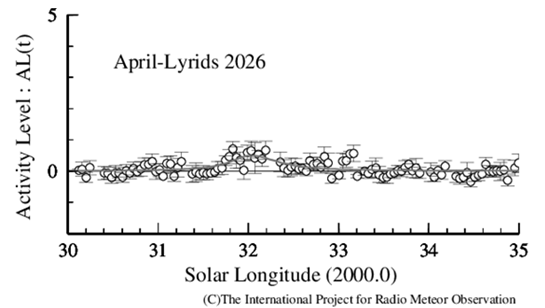
観測ピーク値
| Time(UT) | Solar Long. | Activity Level |
|---|---|---|
| Apr. 22 07h | 31°.83 | 0.7 ± 0.2 |
流星群活動推定構造
| Comp.No. | Peak Time(UT) | Solar Long. | A(max) | FWHM(hr) |
|---|---|---|---|---|
| LYR26C01 | Apr. 22 12h30m | 32°.03 | 0.5 | -7.0/+9.0 |
使用パラメータ
- Radiant : α = 271°.4, δ = +33°.6
- Radian Elevation : 20° < h
- Using data within ± 0.50 σ in all observed data.
参考文献
- Radio Meteor Observation in Japan (RMOJ)
- Radio Meteor Observation Bulletin (RMOB)
- Jenniskens P., Crawford C., Butow S. J., Nugent D., Koop M., Holman D., Houston J., Jobse K., Kronk G., and Beatty K. (2000). “Lorentz shaped comet dust trail cross section from new hybrid visual and video meteor counting technique imprications for future Leonid storm encounters”. Earth, Moon and Planets, 82–83, 191–208.
- Ogawa H. and Christian S. (2017). “Major and Daytime Meteor Showers using Global Radio Meteor Observations covering the period 2001-2016”. WGN, the Journal of the IMO, 45, 98-106.